Ask a room of proposal professionals what wins work and you’ll get a consistent answer. Not the writing. Not the perfect budget. What wins is proof that the firm has done this before, with people who have relevant experience.
That answer now has concrete numbers behind it. In a survey of 429 proposal, marketing and business development professionals, conducted by stargazy in partnership with Flowcase, 64% placed relevant past experience among the top two factors in whether their firm wins. Relationships came second at 46%. Quality of writing, which absorbs most of the hours in a proposal cycle, ranked near the bottom.
This is consistent with how procurement works. Qualifications-based selection asks public buyers to evaluate demonstrated experience before they look at price. An SF330 is essentially a request for proof. Firms pursue work they can show they’ve done, because that’s what the scoring rewards.
The thing that wins is the thing teams can’t find
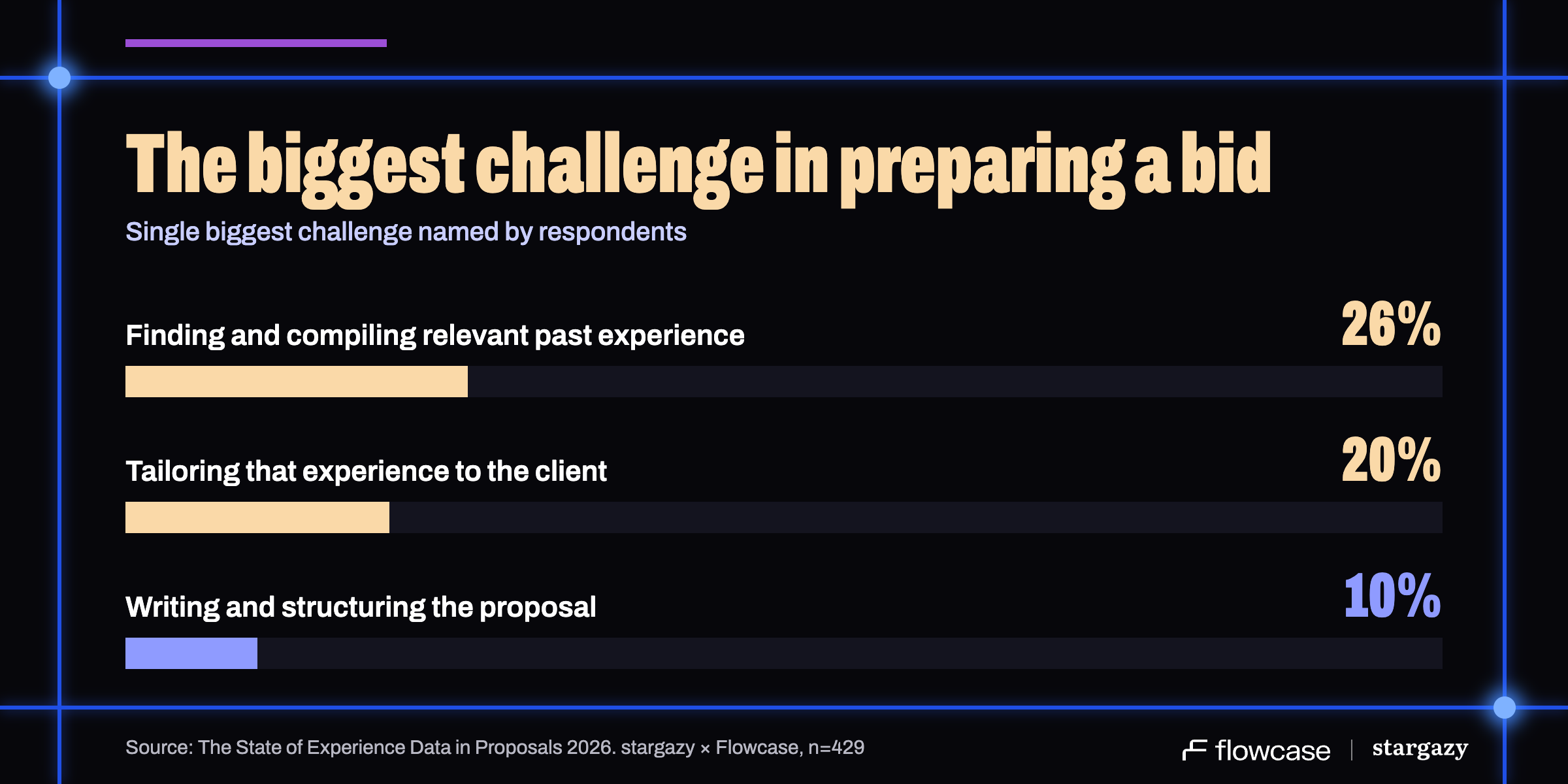
Now look at the other side of the same survey. When asked to name their single biggest challenge in preparing a bid, the top answer was finding and compiling relevant past experience, at 26%. The second was tailoring that experience to the specific client, at 20%. Writing and structuring the proposal came in at 10%.
So the factor that most determines the outcome is also the step teams struggle with most. And the step that gets most of the technology budget, drafting faster, is the one practitioners rank as the least of their problems.
Proposal technology spending has concentrated on producing content faster. The bottleneck sits earlier, before anyone opens a document. Firms have the proof they can do the work. What they don’t have is a reliable way to put their hands on it before the deadline.
Why it persists: the content exists
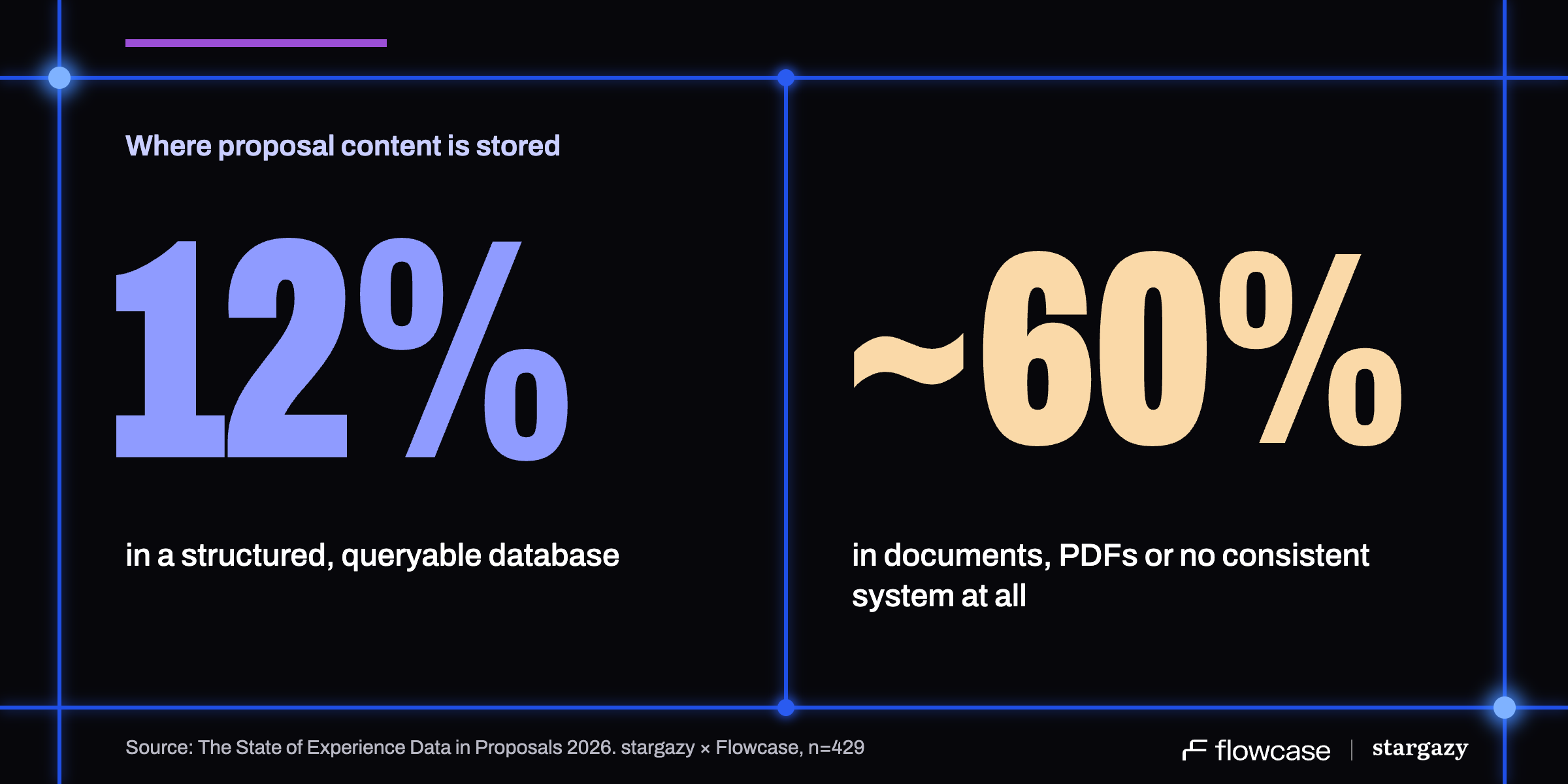
Only about 12% of respondents store proposal content in a structured, queryable database. Roughly 60% keep it in documents, PDFs or no consistent system at all.
That explains why the problem survives. The project sheet from the 2021 wastewater pursuit exists. The resume of the engineer who led it exists. Everyone knows roughly where to look. Knowing a document exists and being able to retrieve it, confirm it’s current, and tailor it by Thursday are different capabilities, and most firms have only built the first one.
The most valuable asset with the least care
A consulting or engineering firm sells one thing: the people who do the work and the record of what they’ve done. The firm’s reputation, its ability to pass go/no-go, its score on a qualifications matrix, all of it rests on that record.
It’s also the worst-kept data in the building. Finance has a system of record, an owner and an audit. HR has the same. Project experience has a folder structure, a few versions of each file, and whoever remembers where the good one is.
Where to start
Here are three questions you should ask yourself to give your firm its baseline of where your team stands today:
- How long did your last major proposal take to assemble experience content for?
- When was your most-used project reference last updated?
- Who is accountable for keeping it current, by name?
If the answers are “days,” “not sure” and “nobody,” the firm has identified where its next proposal investment should go, and it isn’t a faster writing tool.
The full report, The State of Experience Data in Proposals 2026, covers the confidence gap between leaders and proposal teams, the bids firms are declining because they can’t prove their experience, and what AI does with content nobody has maintained.