.svg)
.png)
For years, I have watched proposal teams do the same thing under pressure. An RFP lands. Someone reads it three times to pull out every role and requirement. Then the hunt begins. Who has done a project like this before? Where is their current CV? Is that project sheet still accurate, or is it two years out of date? By the time the right people and projects are found, you’re now 2 days closer to the deadline.
This is the part of proposals that AI was supposed to fix. While AI tools like ChatGPT, Claude, Copilot and proposal AI tools can help you write perfectly worded content based on your context, the content is only going to be as good as the data feeding it.
Firms do not win work because they wrote the fastest proposal. They win because they can prove they have the right people, with relevant experience, and a track record on similar projects. That is the problem our new AI Proposal Assistant is built to solve. It launches publicly today, and I want to explain why we built it the way we did.
What the AI Proposal Assistant does
The AI Proposal Assistant turns an RFP into a compliant, well-staffed starting point for your proposal team. It does this in three ways.
It imports requirements. Drop in an RFP and the assistant pulls out every role and requirement automatically. No more reading the document three times and building a checklist by hand. The work that used to eat your first morning now takes minutes.

It suggests staffing. The assistant matches the right people to each role using live profile data, not stale documents. It looks across your whole firm, including the offices and acquired teams your proposal coordinators may never have met, and surfaces the people who actually fit the role.
.avif)
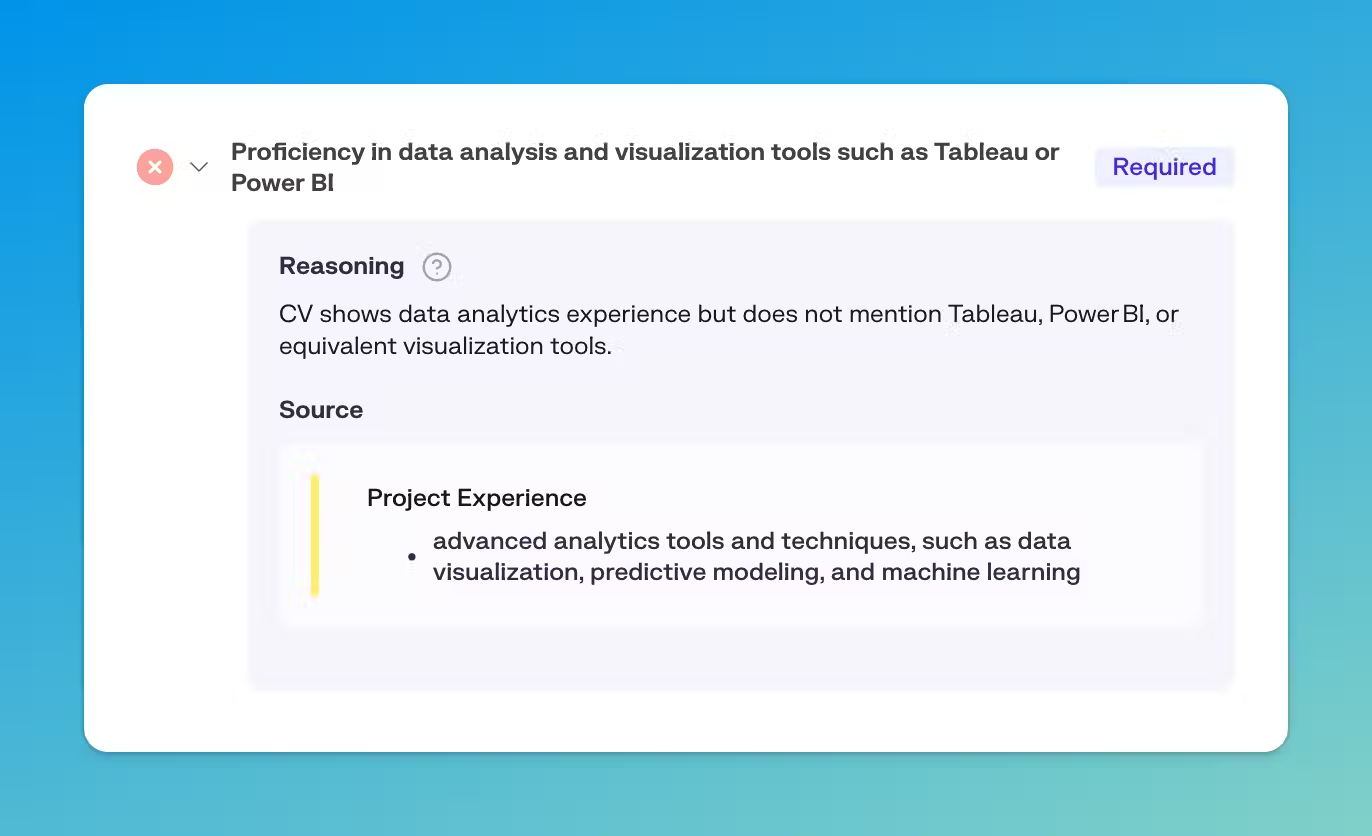
It checks compliance continuously. As you build the proposal, the assistant shows you exactly where you meet or miss each requirement, with the evidence behind it. When a check comes back negative, you get the reasoning and a list of relevant sources from your CVs, so you can act instead of guess. We designed the matching with multiple validation layers and no false positives, which means a positive match is one you can trust.
Why this matters for proposal teams
If you run proposals for a large firm, you know the burden of finding the right people for each bid, making sure the content is up to date, making sure you meet all requirements, and generating this content in an on-brand document.
The AI Proposal Assistant attacks those directly.
- Requirement import removes the manual checklist.
- Staffing suggestions replace the all-staff email asking something like “who has done water treatment work in the Midwest”.
- Continuous compliance checking gives you a live view of where the bid stands, so the gaps are visible while you still have time to close them.
Why we care about data, not documents
Flowcase has always been the system of record for people and project experience at professional services firms. Every CV, resume, project sheet, and credential lives in one structured place, kept current by the people who own it.
That foundation changes what AI can do. When the data underneath is live and structured, AI can search it, match against it, and check work against it with confidence. When the data is a pile of old documents, AI guesses. It pulls a name from a proposal written four years ago and presents a stale resume as a current one. Nobody catches it until a client does. In fact, many studies have shown that AI generated content based on structured data can improve output accuracy and quality by 50-60%.
You can connect our MCP to any of your favorite LLMs (ChatGPT, Claude, Copilot, etc.) to be able to pull truly accurate data and generate content there. This is what AI tools are best at. What we are best at is managing the data behind your past experience.
What comes next
This is a starting point, not a finish line. We are already working on tailoring suggestions and reference project matching, so the assistant helps you shape content for a specific client and pull in the past projects that prove your case. We will keep refining the experience with the same principle that guided this launch. The data comes first. The AI works on top of it.
A proposal is a promise about who will do the work and whether they have done it before. Our job is to make that promise easy to keep, backed by experience you can stand behind. That is what the AI Proposal Assistant is for.